
Quick Summary
Maintaining proper humidity control for vegetables is critical to prevent premature wilting, shriveling, and fungal decay across various indoor storage spaces. Different produce varieties require specific relative humidity levels ranging from 60% to 98%, which specialists like Super Green Insulation Austin note relies heavily on insulated building envelopes to eliminate disruptive thermal swings and condensation. Readers will understand how to separate crops by moisture needs, manage airflow, and optimize pantry microclimates to maximize produce freshness and shelf life.
Humidity Control for Vegetables: Keep Produce Fresh and Crisp
When fresh produce wilts, shrivels, or rots ahead of time, the culprit is almost always poor moisture balance in the air. Fresh vegetables lose quality rapidly when stored in spaces where the relative humidity (RH) fails to match their botanical makeup. Maintaining proper humidity control for vegetables stops water from evaporating out of plant cells, preserving crispness and shelf life.[1]
Note: The following building-envelope and insulation discussion is explanatory context not verified by the research brief. While many people focus solely on refrigerator settings, storage stability often comes down to the surrounding building envelope. In hot, humid climates like Central Texas, radiant attic heat and uninsulated pantry wall cavities create strong vapor drives and temperature spikes. These thermal swings dry out indoor air, wreck vegetable storage humidity levels, and cause produce to spoil days before it should.
Fast Storage Rules for Produce Humidity
Quick Summary: Most vegetables store best at about 80%-95% RH, with many leafy and root crops needing about 90%-98% RH to prevent water loss and wilting. In contrast, cured crops such as dry onions, garlic, and sweet potatoes require moderate relative humidity of about 60%-80% RH to prevent fungal decay and premature sprouting.[3]
Managing humidity involves balancing ambient air moisture against crop transpiration. Living plant tissues breathe and release moisture after harvest. If the surrounding air is too dry, vegetables rapidly pump out their internal water reserves. If the air is saturated without proper air movement, moisture pools on the skin and triggers fungal rot.
| Storage Group | Target Relative Humidity | Common Vegetables | Primary Spoilage Risk |
|---|---|---|---|
| High-Moisture Crops | 90% – 98% RH | Lettuce, spinach, broccoli, carrots, radishes | Transpiration, limp leaves, surface shriveling |
| Moderate-Moisture Crops | 85% – 90% RH | Cucumbers, peppers, snap beans, summer squash | Chilling injury, skin pitting, gradual moisture loss |
| Dry & Cured Crops | 60% – 80% RH | Dry onions, garlic, shallots, sweet potatoes | Mold, neck rot, root sprouting |
How Building Envelopes and Vapor Drive Impact Storage
Note: This section regarding building envelopes and insulation provides explanatory context not verified by the research brief.
Most home storage advice focuses on crisper drawers, but pantry closets, basements, and cold rooms bear the brunt of building envelope failures. In warm climates, an attic can easily reach 130 degrees Fahrenheit. If a pantry or walk-in cooler shares an uninsulated wall cavity with an attic chase or exterior brick facade, heat bleeds directly into the storage zone.
This heat transfer creates two major problems for vegetable preservation:
- Vapor Drive and RH Drops: Warm air holds more moisture than cool air. When uninsulated walls heat up a storage space, the relative humidity automatically plunges, even if the absolute moisture content stays the same. The dry, heated air quickly pulls water straight out of your produce.
- Condensation Cycles: As central air conditioning cycles on and off, wall temperatures swing rapidly. Warm, moist air hitting cool shelving surfaces causes condensation droplets to form directly on vegetable skins, creating an ideal breeding ground for mold spores.
Whether you manage a commercial cold room, a dedicated root cellar, or a residential pantry, proper thermal insulation and air sealing are the first line of defense. According to building envelope specialists like Super Green Insulation Austin, spray foam insulation or dense-pack fiberglass in storage wall cavities stabilizes ambient temperatures, keeping relative humidity within target ranges without heavy mechanical dehumidification.[2]
Relative Humidity Requirements by Crop Type
Need humidity control vegetables?
We’re available now — call for a fast, free estimate.
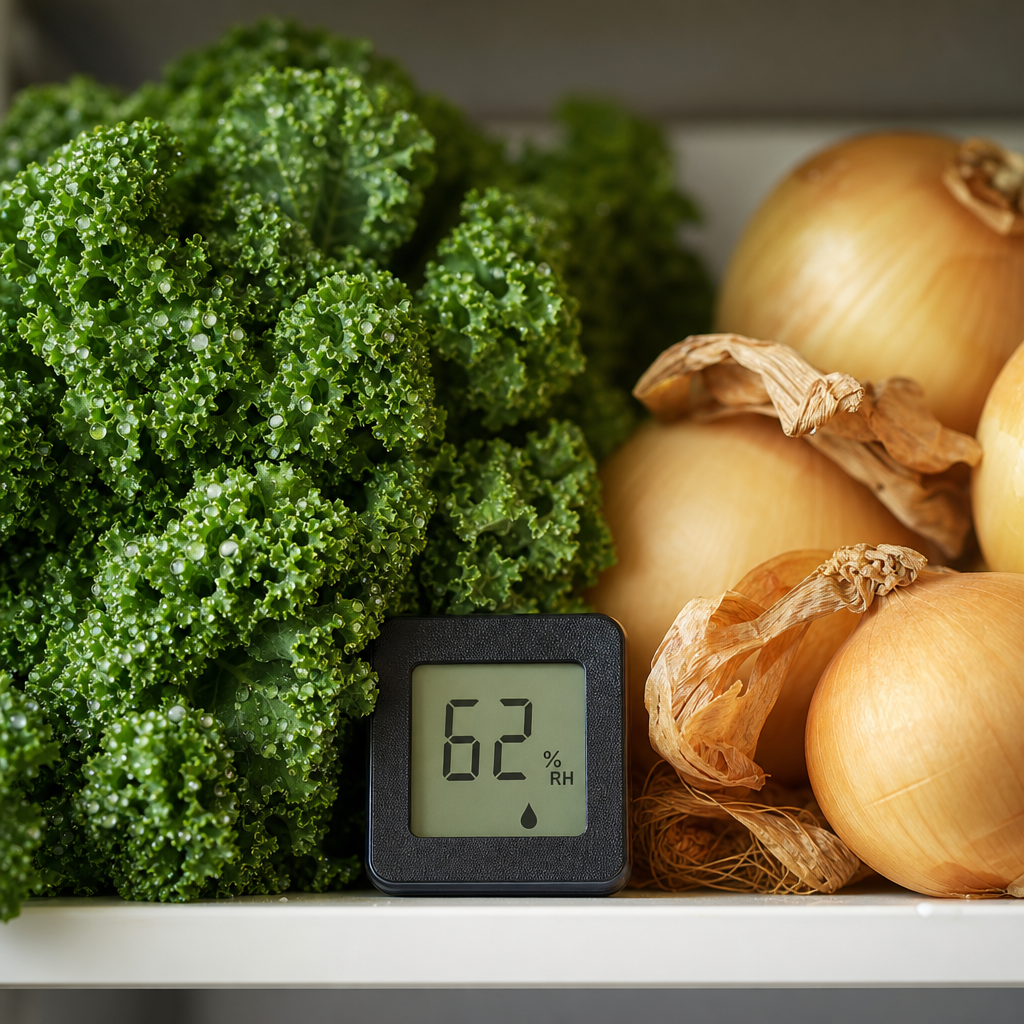
Keeping produce fresh requires separating crops based on their postharvest transpiration rates and moisture tolerances.
High-Humidity Crops (90% to 98% RH)
Leafy greens, brassicas, and root vegetables have thin skins and large surface areas, making them vulnerable to desiccation. Storing them at 90% to 98% RH slows water loss to a crawl. For commercial coolers and root cellars, misting systems or damp burlap covers help maintain this near-saturated environment. In standard pantries or refrigerators, micro-perforated bags protect produce while letting gases escape.
Dry and Cured Storage Crops (About 60% to 80% RH)
Alliums like onions and garlic, along with cured sweet potatoes, need dry, well-ventilated storage at about 60% to 80% RH. High moisture causes the dormant root nodes on garlic and onions to break rest and send out green shoots. Keep these crops in dark, aerated bins away from high-moisture vegetables and moisture-producing appliances.[5]
Preventing Mold in High-Humidity Environments
Maintaining high humidity without inviting mold requires controlled airflow and surface hygiene. Mold spores thrive on static moisture, not just ambient vapor.
- Gentle Air Movement: Install low-velocity fans in cold rooms and walk-in coolers. Air must circulate evenly across storage bins to eliminate stagnant pockets without blowing hard enough to dry out produce.
- Sanitized Contact Surfaces: Clean storage bins, wire shelving, and walls with food-safe sanitizers before loading new stock. This removes fungal spores that latch onto surface moisture.
- Vapor-Sealed Boundaries: Seal wall penetrations, electrical outlets, and baseboards in pantries and cold rooms. Unsealed gaps let in warm, humid outdoor air, creating localized condensation points that accelerate rot.
Frequently Asked Questions
What happens when humidity levels drop too low?
When relative humidity drops below 80% for fresh vegetables, water evaporates out of the plant cells and into the dry air. This process causes increased wilting and moisture loss in leafy greens, rubbery textures in root crops like carrots, and noticeable weight loss in commercial produce batches.
What is the ideal humidity level for general vegetable cold storage?
Most vegetables store best at about 80%-95% RH, with many leafy and root crops needing about 90%-98% RH to balance moisture retention while avoiding excessive saturation that encourages mold growth.
Can you store potatoes and onions together?
Generally, no. As a crop-specific consideration, onions require a drier environment (about 60% to 80% RH) and can release gases that affect other produce, while potatoes typically require higher humidity (around 90% to 95% RH) to prevent shriveling. Rather than treating this as a universal rule, separate, well-ventilated storage zones are recommended based on specific crop needs.
How does insulation protect vegetable storage areas?
(Explanatory context not verified by the research brief) Insulation acts as a thermal and vapor barrier. By stopping outdoor heat and moisture from penetrating storage wall cavities, insulation prevents indoor temperature swings. Stable temperatures keep relative humidity steady, eliminating the condensation and dry spells that ruin produce.[4]
Need humidity control vegetables?
We’re available now — call for a fast, free estimate.
Sources
- [PDF] The Commercial Storage of Fruits, Vegetables, and Florist and … – ars.usda.gov (2016)
- [PDF] Vegetable Gardening in South Dakota – SDSU Extension – extension.sdstate.edu (2019)
- Relative Humidity: A Key to Successful Potato Storage – fyi.extension.wisc.edu
- Storage Life of Vegetables – SDSU Extension – extension.sdstate.edu
- HIGH HUMIDITY STORAGE OF VEGETABLES AND … – journals.ashs.org
Related reading: Home Humidity Levels in Winter | Call Now-10% Off | Same-Day Service | Free Estimate
Related reading: Home Humidity in Winter – 10% Off & Free Estimate – Same-Day Service
Related reading: Lowering Humidity – Call Now-10% Off – Same-Day Service – Free Estimate
Frequently Asked Questions
How can I fix a home pantry that experiences severe temperature and humidity swings?
Uninsulated wall cavities and unsealed gaps allow outdoor heat to penetrate storage spaces, driving down relative humidity and drying out produce. Sealing air leaks and scheduling a free home moisture and insulation inspection with Super Green Insulation Austin can help stabilize pantry microclimates for lasting vegetable freshness.
What is the best way to monitor and balance different vegetable humidity zones at home?
Place a digital hygrometer directly at shelf level to track relative humidity shifts between different storage areas. You can create separate microclimates by placing high-moisture greens in micro-perforated produce bags while keeping cured alliums in open, ventilated bins.
Why does condensation form on stored vegetables even when room humidity seems normal?
Condensation occurs when rapid indoor temperature swings cause warm air to meet cooler storage surfaces, causing air moisture to instantly liquefy onto produce skin. Ensuring consistent wall insulation and maintaining gentle, low-velocity air circulation prevents these sudden thermal drops and protects crops from mold.
About the author
 |
Marcus Donovan Marcus Donovan is a certified energy auditor and home performance specialist with over 12 years of experience in the Austin construction industry. He holds a Bachelor of Science in Construction Management from Texas State University and focuses on residential and commercial energy efficiency. His practical knowledge covers everything from attic insulation retrofits to complex moisture control systems. |