
Quick Summary
Effective mold remediation in Austin requires addressing root-cause moisture problems and contaminated materials rather than relying on simple surface cleaning. Super Green Insulation Austin emphasizes that damp attic insulation must be completely removed and underlying condensation issues resolved to protect indoor air quality and structural integrity. Homeowners will understand average local remediation costs, Texas compliance standards, and how to schedule an inspection to resolve attic and crawl space moisture issues permanently.
Mold Remediation in Austin: Fix Moisture and Mold Fast
If you are dealing with mold in your Austin home, surface cleaning may not address contaminated porous materials or the moisture source, while remediation addresses removal and moisture correction when required.[3]
Austin Code resources address moisture sources such as leaks and water intrusion, while Austin property-maintenance guidance identifies AC, plumbing, roof, and ventilation problems as maintenance concerns. Records analyzed by Austin Code averaged 29 monthly violations involving water-damaged interior surfaces, or about 4.62% of monthly violation cases. These records reflect water-damage and moisture-related code violations rather than confirmed mold cases or remediation projects.[1]
Below, you will find independent modeled cost estimates and an overview of the remediation process.
What to Expect During Austin Mold Remediation
Remediation generally involves professional assessment, removal of mold-contaminated materials where appropriate, moisture correction, and compliance with applicable Texas licensing and work-plan requirements.
How Much Does Professional Mold Remediation Cost in Austin?
Remediation costs depend on the square footage affected, how easy the space is to access, and the extent of moisture intrusion. Independent modeled estimates place attic remediation at approximately $1,889, while a whole-house remediation midpoint is modeled at around $9,740. These figures represent independent modeled estimates rather than fixed bids; your actual cost will reflect your home’s specific conditions.
Cost Estimates
| Service Scope | Estimated Cost |
|---|---|
| Attic Remediation | ~$1,889 (Independent modeled estimate) |
| Whole-House Remediation | ~$9,740 (Independent modeled midpoint) |
What Drives Your Final Estimate?
Several practical factors determine where your project lands on the cost spectrum:
- Accessibility: Tight crawl spaces or low-pitch attics may require extra setup time and specialized equipment.
- Moisture Source Complexity: A simple leak repair generally requires fewer resources to address than extensive duct condensation issues.
- Material Replacement: If porous insulation is contaminated, costs may include removing the damaged material and replacing it once the area is dry.
Moisture Factors in Attics and Crawl Spaces
Need mold remediation in Austin?
We’re available now — call for a fast, free estimate.
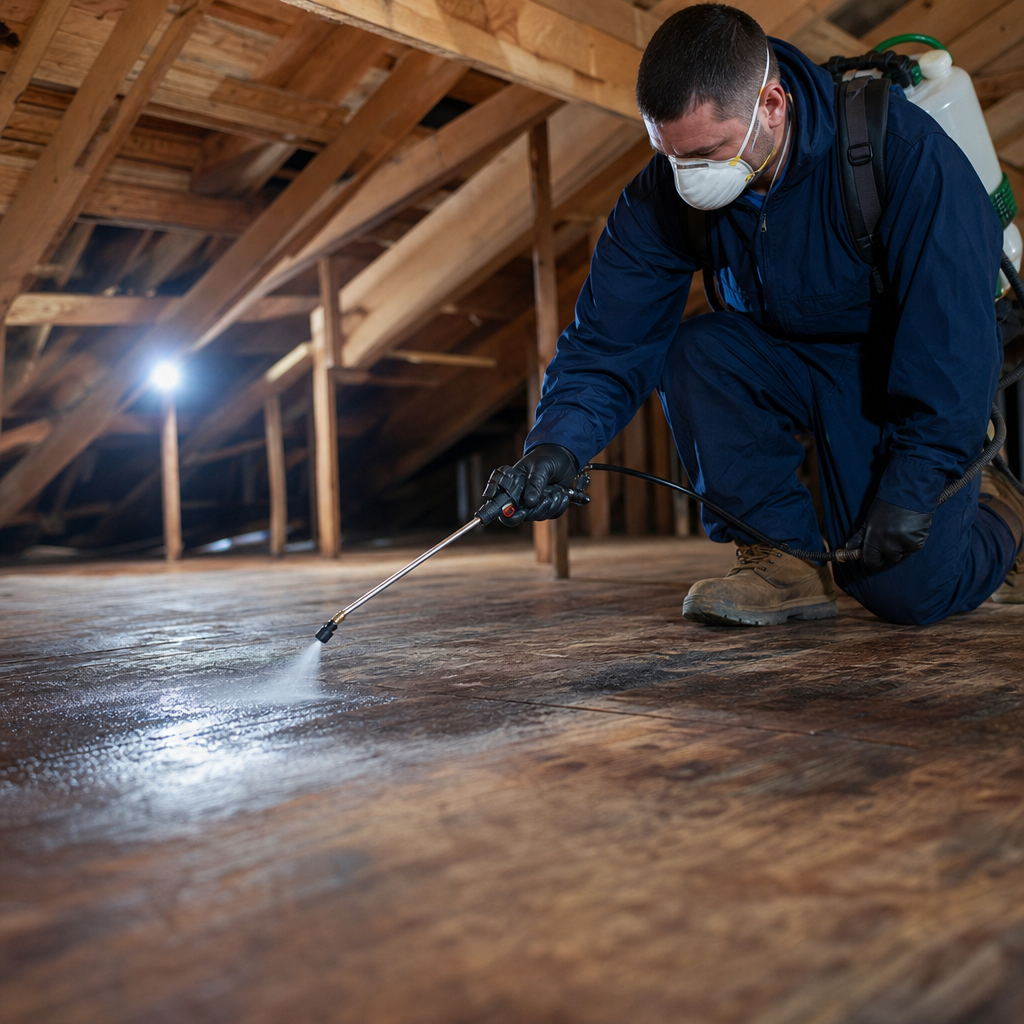
Moisture issues in homes often stem from building envelope and condensation dynamics.
The Thermal Envelope and Condensation
When warm, humid air in an attic contacts surfaces cooled by air conditioning below their dew point, moisture can condense on framing and drywall.
This moisture can create conditions suitable for mold growth. According to a 2007 review published by the U.S. Department of Energy Office of Scientific and Technical Information, damp indoor environments and mold exposure correlate with a 30% to 80% increase in respiratory and asthma-related symptoms.[4]
HVAC Ducts and Insulation
Uninsulated or poorly sealed air ducts running through unconditioned spaces can potentially develop condensation that drips into surrounding insulation. According to Super Green Insulation Austin, wet insulation can lose its thermal resistance, remain damp, and potentially lead to wood rot if left uncorrected.[2]
What Is the Difference Between Mold Removal and Remediation?
Surface cleaning may not address contaminated porous materials or the underlying moisture source, while remediation addresses removal of contaminated materials and moisture correction when required.
Do not hire contractors who recommend fogging or spraying chemicals instead of mold removal as the way to clean up. Moldy materials must be removed from the building.
Surface Treatment vs. Remediation
A 1998 study examining 48 Texas schools demonstrated that reported staff health complaints dropped significantly after mold was removed.
| Remediation Feature | Basic Surface Cleaning | Full Remediation |
|---|---|---|
| Contaminated Porous Materials | May only clean visible surfaces | Removes contaminated materials where appropriate |
| Moisture Source Correction | Often unaddressed | Identifies and corrects underlying moisture sources |
| Regulatory Standards | Informal cleaning | Complies with applicable Texas licensing and work plans |
Frequently Asked Questions About Austin Mold Remediation
Does homeowners insurance cover mold removal in Austin?
Coverage depends on the policy and moisture cause. Sudden and accidental water damage may be covered, while gradual leaks, seepage, flooding, and maintenance-related damage are commonly excluded, with policy-specific exceptions and limits.
Can wet or contaminated attic insulation cause mold to spread indoors?
Air movement between unconditioned attics and living spaces can transport air, dust, and particles through ceiling bypasses, penetrations, and access hatches. As recommended by Super Green Insulation Austin, addressing moisture and contaminated materials helps prevent these pathways from affecting indoor spaces.
How long does the mold remediation process take?
Residential remediation projects typically take from one to several days depending on the square footage, extent of moisture, and scope of work required under the project work plan.
What areas around Austin typically require mold remediation?
Moisture and mold issues can occur across Central Texas properties, including Central and East Austin, West Lake Hills, South Austin, Round Rock, Pflugerville, Del Valle, and Northwest Austin, where seasonal weather and moisture sources affect residential building envelopes.[5]
Need mold remediation in Austin?
We’re available now — call for a fast, free estimate.
Sources
- Code Compliance Resources | Austin Development Services – austintexas.gov (2025)
- rows.csv?accessType=DOWNLOAD – data.austintexas.gov (2023)
- City of Austin Memorandum – services.austintexas.gov (2021)
- Health effects associated with dampness and mould – ncbi.nlm.nih.gov (2007)
- THIS IS YOUR PRESENTATION TITLE – services.austintexas.gov (2021)
Frequently Asked Questions
Why must wet insulation be completely removed during attic mold remediation?
Porous insulation materials like fiberglass and cellulose cannot be effectively cleaned once contaminated and will permanently lose thermal resistance when wet. Super Green Insulation Austin safely removes damp, contaminated insulation and sanitizes the area to prevent mold spores from spreading into your living spaces.
How can homeowners prevent mold from returning to attics and crawl spaces?
Long-term prevention requires correcting moisture dynamics by air-sealing attic bypasses, insulating ductwork, and installing crawl space vapor barriers. Homeowners can schedule a free on-site inspection with Super Green Insulation Austin to identify root moisture causes and implement permanent remediation solutions.
What are the warning signs that attic mold is infiltrating indoor living areas?
Persistent musty odors, aggravated allergy symptoms, and dark stains around ceiling penetrations or HVAC vents suggest conditioned air is drawing attic contaminants into the home. Addressing these air leaks along with professional moisture remediation stops spore transfer through the thermal envelope.
About the author
 |
Sarah Jenkins Sarah Jenkins is an insulation specialist with over 8 years of experience in residential and commercial energy efficiency. Holding a Bachelor of Science in Environmental Science from Texas A&M University, she focuses on practical solutions for climate control in Central Texas. Her expertise lies in rapid-response attic and crawl space restoration, helping Austin property owners reduce utility costs and improve indoor comfort. |