
Quick Summary
Effective water damage repair requires immediate water extraction and structural drying to prevent trapped moisture from compromising framing, attics, and crawl spaces. Super Green Insulation Austin highlights that removing saturated insulation and sanitizing confined cavities is crucial to halting structural rot and preventing recurring mold growth. After reading, homeowners will understand how to navigate restoration costs and insurance coverage while being prepared to request an immediate inspection for vulnerable attic and crawl space areas.
Water Damage Repair: How to Restore Your Home Fast
When standing water enters your living space, prompt action is essential to effective cleanup and moisture control. Water damage repair typically focuses on stopping the source, extracting standing water, drying structural framing, and removing materials that cannot be restored. Repair costs depend on the volume of water, its source, and how deeply it penetrated building materials. While neutral research does not establish a single official national average, commercial estimates reported by Angi place a typical average around $3,869, with standard projects spanning from roughly $450 to $16,000. According to the Insurance Information Institute, about 1 in 60 insured homes had a property-damage claim caused by water damage or freezing.[3]
According to Super Green Insulation Austin, an important consideration during water extraction is addressing wet insulation trapped in wall cavities, ceilings, or floors. When insulation remains wet against framing, it can trap moisture inside enclosed cavities, making thorough structural drying necessary.
Quick Answer: The Steps to Recovery
Effective water damage restoration generally involves stopping the water source, removing standing water, promoting air movement and dehumidification, and verifying moisture levels before closing walls or ceilings. Depending on the situation, slightly damp, promptly dried, uncontaminated insulation may be salvageable, while saturated or contaminated porous insulation may require removal and replacement after assessment. Once framing and materials are verified dry, repairs can proceed.
How Much Does Professional Water Damage Repair Cost?
The total cost for water damage restoration generally depends on the affected square footage, how long water remained, and whether moisture reached hidden spaces like attics or crawl spaces. Clean water from a broken supply line typically involves different remediation needs than water from appliances or outdoor flooding.
Key Factors That Shape Repair Costs
Restoration projects involve job-site conditions that influence pricing:
- Water Source and Cleanliness: Clean water from supply lines generally requires basic drying, whereas contaminated water or floodwater involves additional containment, safety measures, and material disposal.
- Accessibility: Working in confined spaces such as crawl spaces, attics, or behind complex building materials can increase labor requirements.
- Material Removal vs. Drying in Place: Some materials may be dried in place using dehumidifiers and air movers, while heavily saturated or contaminated porous materials often require removal and replacement.
Insurance may help cover these expenses depending on the policy and the cause of damage. According to Federal Emergency Management Agency (FEMA) records, the National Flood Insurance Program (NFIP), which was the largest single-line insurance program in the United States as of 2025, has processed more than 2.7 million claims since its creation in 1968.[1]
Can Water-Damaged Insulation Be Saved, or Must It Be Replaced?
Need water damage repair?
We’re available now — call for a fast, free estimate.
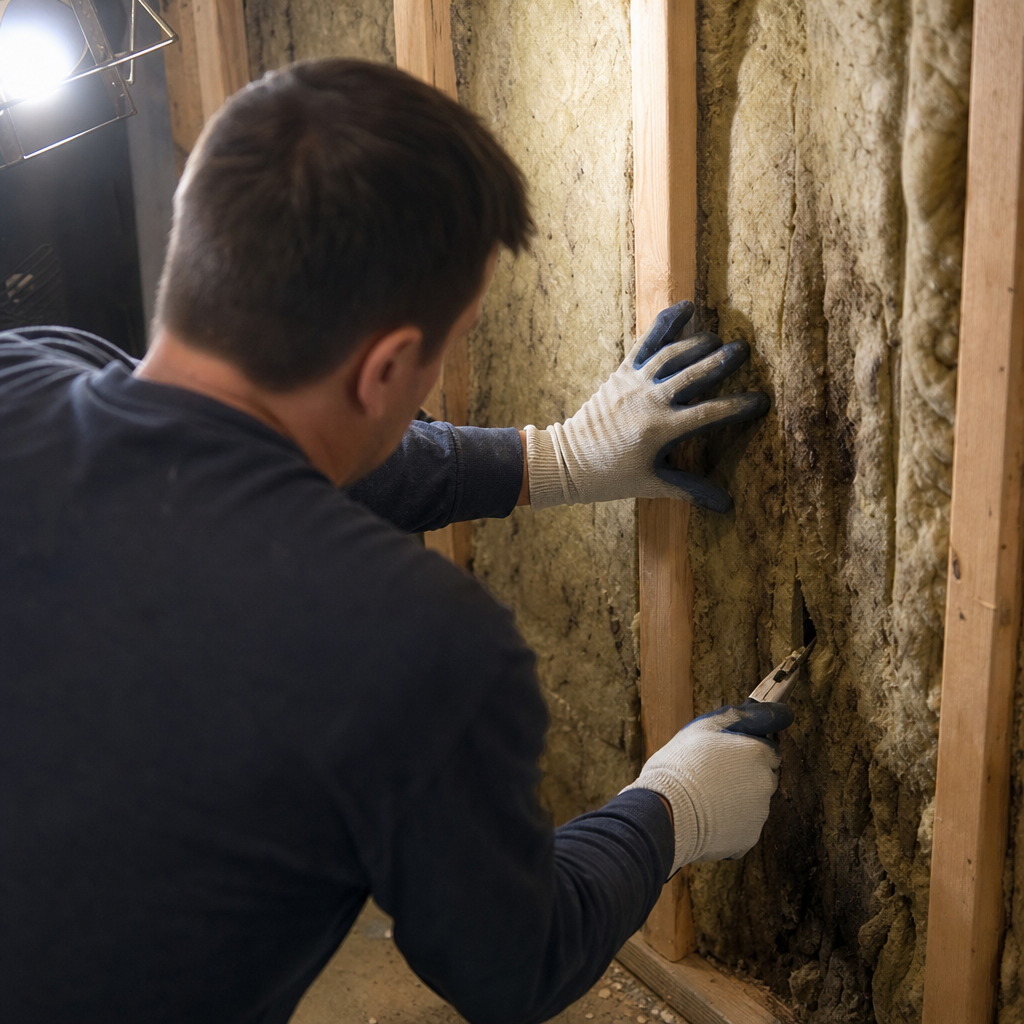
Whether water-damaged insulation can be saved depends on the type of material, the water source, and the degree of saturation. Slightly damp, promptly dried, uncontaminated insulation may be salvageable, while saturated or contaminated porous insulation may require removal and replacement after assessment.
Moisture Effects on Saturated Insulation
When porous insulation materials such as fiberglass batts, loose-fill cellulose, or mineral wool become heavily saturated, water displaces trapped air. Saturated insulation can become compressed and heavy, which may reduce its thermal performance. As experts at Super Green Insulation Austin point out, if the material cannot be effectively dried or has lost its structure, replacement is often recommended.
Trapped Moisture in Wall and Ceiling Cavities
Leaving wet insulation packed inside closed wall bays or ceiling joists can hinder the drying of surrounding wood framing. Removing saturated insulation allows direct airflow across exposed structural lumber so framing assemblies can dry completely before walls are closed.
How Structural Moisture Is Dried in Walls, Attics, and Ceilings
Drying water-damaged structural components involves removing moisture and monitoring conditions until building materials reach acceptable levels.
Moisture Detection and Assessment
Water can travel along framing paths away from the original leak source. Restoration professionals use moisture meters and thermal imaging tools to locate damp areas and evaluate moisture levels across walls, subfloors, and ceilings.
Air Movement, Dehumidification, and Cavity Drying
Once damaged or unsalvageable materials are addressed, structural drying typically includes:
- Targeted Extraction: Removing standing water from floors and accessible cavities.
- Air Movement: Using air movers to circulate air across damp framing and structural materials to facilitate evaporation.
- Dehumidification: Operating dehumidifiers to extract moisture vapor from the air and maintain effective drying conditions.
- Moisture Verification: Checking moisture levels in framing and other materials before closing cavities or completing final repairs.
Does Homeowners Insurance Cover Water Damage Repair?
Sudden and accidental water damage is generally covered under standard homeowners insurance policies, subject to individual policy terms, conditions, and limits.[4]
Sudden and Accidental Events vs. Gradual Damage
- Generally Covered: Sudden and accidental incidents, such as burst pipes or sudden appliance failures, depending on specific policy terms.
- Generally Excluded: Gradual damage resulting from continuous or long-term leaks, deferred maintenance, or routine wear and tear.
Flood Insurance and Endorsements
Standard homeowners insurance policies generally exclude flood damage resulting from outdoor flooding or rising waters. Flood protection typically requires a separate policy, such as one through the National Flood Insurance Program (NFIP) or a private flood insurer. In addition, damage from sewer or drain backup is commonly excluded under standard policies and may require a separate endorsement or rider.[2]
Frequently Asked Questions About Water Damage Repair
How quickly should water mitigation begin?
Mitigation should begin as promptly as possible. According to Super Green Insulation Austin, starting water extraction and drying quickly helps limit the spread of moisture to adjacent building materials and reduces the risk of secondary damage.
How long does the structural drying process take?
The time required for structural drying varies based on the extent of water intrusion, the types of materials affected, ambient humidity, and the drying equipment used. Moisture levels should be monitored until materials are verified dry.
Why is crawl space moisture management necessary after a leak?
When plumbing leaks affect a crawl space, standing water and elevated humidity can impact subfloors and framing above. Removing standing water, promoting airflow, and addressing moisture in the crawl space helps protect framing and manage overall indoor humidity.
Need water damage repair?
We’re available now — call for a fast, free estimate.
Sources
- Introduction to the National Flood Insurance Program (NFIP) – congress.gov (2026)
- national flood insurance program – media toolkit – agents.floodsmart.gov (2025)
- Water Damage Insurance Claim Statistics | Verified 2026 Data – worldmetrics.org (2026)
- Water Leak Detection and Property Insurance Statistics (2026) – rapideyeinspections.com (2026)
Related reading: Mold Remediation in Austin | Call Now-10% Off | Same-Day Service | Free Estimate
Frequently Asked Questions
What happens if water-damaged insulation in an attic or crawl space is not removed?
Leaving wet insulation trapped inside cavities holds moisture against structural framing, causing wood rot, loss of thermal efficiency, and rapid mold growth. Super Green Insulation Austin extracts water-logged insulation and sanitizes confined spaces to prevent recurring mold and preserve structural integrity.
How do you prevent recurring moisture problems in a crawl space after water damage?
Long-term prevention requires drying framing, applying antimicrobial sanitization, and installing durable moisture or vapor barriers across the crawl space ground. Super Green Insulation Austin specializes in crawl space restoration and vapor barrier installation to seal out rising ground humidity.
How quickly should I request an inspection for attic or crawl space water leaks?
You should arrange an inspection immediately after a leak is discovered to stop water from traveling undetected along framing and subfloors. Super Green Insulation Austin offers immediate 24/7 emergency inspections and free estimates to identify hidden moisture and begin structural drying.
About the author
 |
Marcus Donovan Marcus Donovan is a certified energy auditor and home performance specialist with over 12 years of experience in the Austin construction industry. He holds a Bachelor of Science in Construction Management from Texas State University and focuses on residential and commercial energy efficiency. His practical knowledge covers everything from attic insulation retrofits to complex moisture control systems. |