
Quick Summary
Homeowners in Central Texas face attic temperatures reaching 160 degrees, making professional radiant barrier austin installation a critical strategy for reducing HVAC loads and blocking 97 percent of radiant heat. Super Green Insulation Austin acts as the premier local expert, providing transparent pricing and expert diagnostics to determine if a property requires heat-reflective foil, air sealing, or insulation upgrades to maximize efficiency. Property owners can slash annual energy costs and stabilize indoor comfort by contacting Super Green Insulation Austin for a free no-obligation estimate or a rapid 30-60 minute service dispatch.
“`html
Radiant Barrier Austin – Cut Cooling Costs Fast
If you are comparing radiant barrier Austin options, the first question is usually simple: will this actually help your home, or are you better off fixing something else first? In Austin’s summer heat, attic temperatures can climb to 140 to 160 degrees Fahrenheit, and that heat pushes down into bedrooms, hallways, and second stories. A properly installed radiant barrier can help reduce that attic heat load, but only when the attic is a good candidate. If your insulation is already damaged, thin, or contaminated, the better move may be attic air sealing, insulation top-up, or a full replacement.[2]
Super Green Insulation Austin helps homeowners and property managers make that call without guesswork. We offer upfront pricing, free no-obligation estimates, and fast scheduling when a hot attic or failing insulation cannot wait. With 16 years serving Austin properties, our team knows the difference between a quick fix that helps and a project that needs a broader repair plan.
What a Radiant Barrier Costs in Austin and How Fast You Can Get One Installed
Professional radiant barrier installation in Austin typically ranges from $800 to $2,500 for a standard residential project (or roughly $0.30 to $0.60 per square foot, based on Austin-specific data from providers such as Driftwood Builders and Home and Office Insulation). For Austin homes paired with proper ventilation, that puts the payback period in the 4 to 8 year range when you factor in electricity rates around $0.13 to $0.15 per kWh. Note that general Texas data sometimes cites a shorter 2 to 4 year payback window, but Austin-specific research points to the 4 to 8 year range as more representative for local homes. Over a full year, Austin homeowners can often expect about $180 to $400 in lower HVAC spend, based on Austin-specific data – distinct from figures reported in studies of other Texas markets. Actual savings depend on attic design, insulation condition, and how much heat is coming through the roof deck.
That said, savings are not identical from house to house. Homes with ducts in conditioned space usually see smaller gains, often around 2 to 5 percent in cooling costs. If your attic already has strong insulation and tight air sealing, the barrier may still help, but it may not be the first place to spend your money.[1]
For homeowners dealing with extreme heat or a sudden comfort problem, same-day scheduling can matter. Super Green Insulation Austin offers fast dispatch for urgent attic insulation concerns, along with clear pricing before the work begins.
What You Will Need Before Scheduling Installation
Before you book a radiant barrier installation in Austin, gather a few basics so the inspection is useful. Bring a recent summer electric bill, make sure attic access is clear, and note anything unusual you have seen, such as sagging insulation, rodent droppings, moisture staining, or duct damage. Those details help a contractor decide whether a radiant barrier is enough on its own.
Here is a simple checklist to prepare:
- Find a recent cooling bill: This gives you a baseline for measuring savings later.
- Clear access to the attic hatch: Make sure the area is easy to reach so the technician can inspect the space safely.
- Look at the existing insulation: If it is thin, compressed, or dirty, you may need attic insulation in Austin TX along with the barrier.
- Note any moisture or odor issues: Those usually point to a different problem that should be fixed first.
A good inspection should answer more than just “Can I install foil here?” It should tell you whether the attic needs air sealing, blown-in insulation, or cleanup before the radiant barrier goes in.
Step 1: Diagnose Whether a Radiant Barrier Is the Right First Fix for Your Austin Home
Need radiant barrier austin?
We’re available now — call for a fast, free estimate.
Radiant barriers make the most sense when the main problem is heat coming off the roof deck, not air leaking through the house or insulation that has already failed. If your attic insulation is still in decent shape, but upstairs rooms stay hot well into the evening, a barrier may be the right first fix. If the insulation is flattened, patchy, or contaminated by pests, the barrier alone will not solve the issue.
In Austin, the practical rule is this, start with the real cause of heat gain. A radiant barrier helps reflect heat, but it does not replace insulation or air sealing, according to Super Green Insulation Austin. Here is how to think about it:
- Good candidate for radiant barrier only: Your attic already has enough insulation, the HVAC system is working normally, and the main complaint is hot upper rooms in summer.
- Needs radiant barrier plus attic insulation top-up: Your insulation is below target levels, compressed, or uneven across the attic floor.
- Needs a different fix first: You have moisture, mold, duct leakage, or pest damage. In those cases, the underlying problem should be handled before any foil goes in.
If you are not sure where your home falls, a home energy audit in Austin TX is often the fastest way to sort it out. That saves money and keeps you from paying for the wrong upgrade.
Step 2: Understand How Radiant Barriers Work in Austin’s Extreme Heat
Radiant barriers are designed to reflect radiant heat rather than absorb it. In a Texas attic, that matters a lot. Without a barrier, the roof deck absorbs solar heat all day and radiates it downward into the attic space. In peak summer, those attic temperatures routinely reach 140 to 160 degrees Fahrenheit, which is hard on both comfort and HVAC performance.[4]
A properly installed barrier does not add insulation value in the usual R-value sense. Instead, it reduces the amount of heat that reaches the attic floor and the ducts. That is why radiant barrier installation in Austin often works best when it is paired with decent attic insulation and proper ventilation.
For homeowners with older homes, hot west-facing rooms, or overworked ducts in the attic, the difference can be noticeable. For homes with ducts already in conditioned space, the savings are usually smaller.[3]
Step 3: Choose Between Radiant Barrier Foil and Spray Foam for Your Attic
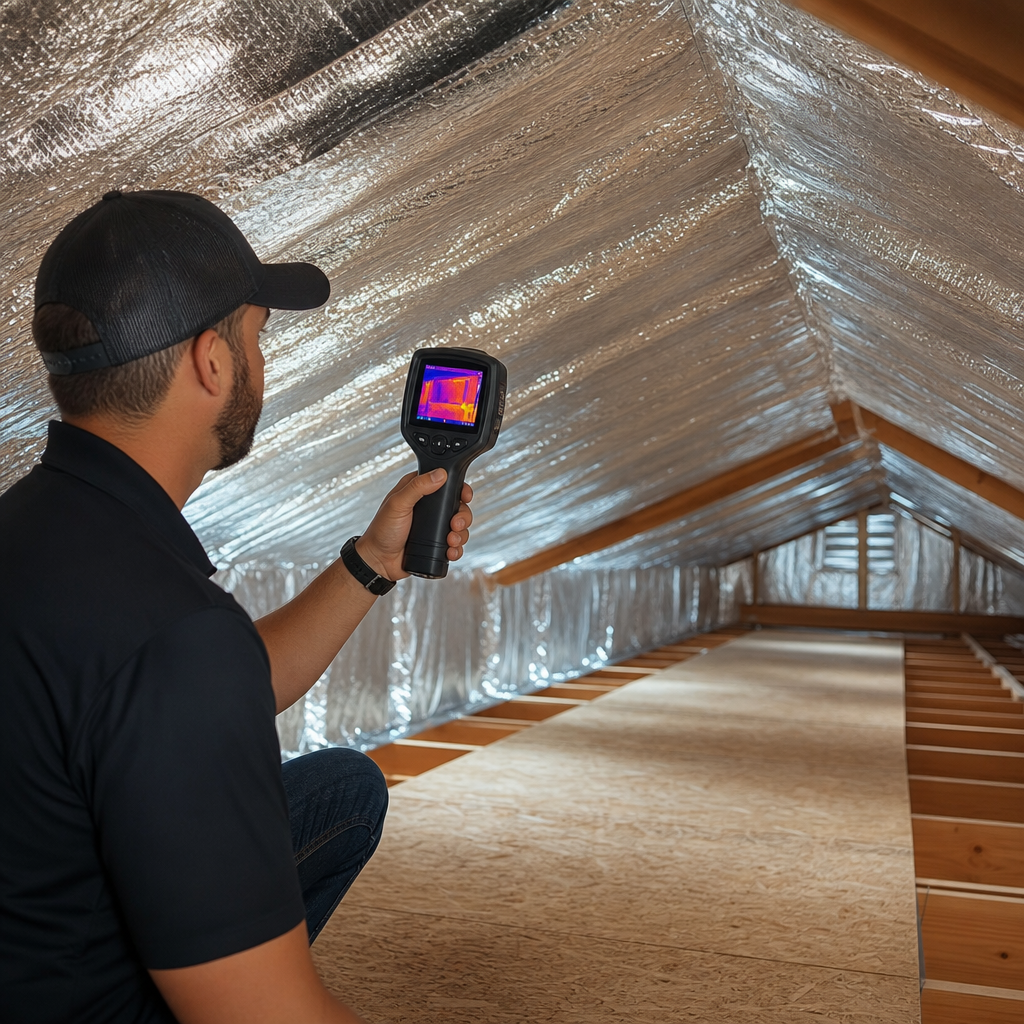
Radiant barrier foil and spray foam solve different problems. Foil reflects heat. Spray foam insulates and air seals. If your attic already has acceptable insulation and you mainly want to reduce summer heat gain, foil is usually the more affordable choice. If you need to turn the attic into conditioned space or you have serious air leakage, spray foam may be the better fit.
Here is a straightforward comparison:
| Feature | Radiant Barrier Foil | Spray Foam | Foil + Blown-In |
|---|---|---|---|
| Cost | Lower | Higher | Mid-range |
| Main function | Reflect heat | Air seal and insulate | Reflect heat and improve insulation |
| Added R-value | None | High | High |
| Best use case | Attic already has decent insulation | Conditioned attic or major air leakage | Older attic with weak insulation |
For most Austin homes, foil plus attic insulation top-up is a practical middle ground. It gives you heat reflection without the cost of a full spray foam conversion.
Step 4: Know What Professional Installation Looks Like and What to Watch For
A proper radiant barrier installation in Austin is installed on the underside of the roof rafters, not laid flat across the attic floor. That air gap matters. It is what allows the reflective surface to do its job. The installer should also keep soffit vents open and avoid trapping moisture in the attic.[5]
Good workmanship is easy to miss if you do not know what to look for, but a few details separate a real installation from a shortcut:
- There should be a clear air space behind the foil.
- Foil should not be stapled flat over floor insulation.
- Ventilation paths should stay open.
- Any damaged insulation, duct leaks, or pest contamination should be addressed first.
That last point matters. If your attic has rodent debris, mold, or soaked insulation, the right move is cleanup and repair before the reflective layer goes in. Otherwise, you are just covering up the real problem.
Step 5: Check for Austin Energy Rebates and Incentives Before You Pay
Need radiant barrier austin?
We’re available now — call for a fast, free estimate.
Before you schedule the work, check whether your project qualifies for any Austin Energy rebate programs or weatherization incentives. These programs change over time, and eligibility can depend on the full scope of the work, not just the radiant barrier itself. Some projects fit better under attic insulation or whole-home efficiency categories.
It is also worth asking whether your upgrade may qualify for federal energy efficiency incentives. A local contractor can point you in the right direction, but if you are making a final tax decision, a tax professional should confirm the details.
If you want help sorting out the paperwork, Super Green Insulation Austin can walk you through the current options during your estimate so you know the real out-of-pocket cost before work starts.
Step 6: Schedule Your Installation and Know What to Expect on Install Day
Most residential radiant barrier jobs take about four to eight hours, depending on attic size and access. The work happens in the attic, so daily life is usually not disrupted much beyond the crew moving through the space and setting up equipment.
On install day, a typical visit looks like this:
- Inspection: The crew checks attic conditions, insulation depth, and any obvious leaks or damage.
- Preparation: Ventilation openings are protected, and the work area is set up for safe installation.
- Installation: Reflective foil is secured to the rafters with the right air gap in place.
- Walkthrough: You get a review of the finished work and any follow-up recommendations.
If you are dealing with an urgent comfort issue, fast response matters. In some cases, the better answer is not just radiant barrier installation in Austin, but emergency insulation replacement if the attic materials are badly damaged or no longer doing their job.
Step 7: Measure Your Results and Protect Your Investment
Once the project is done, the easiest way to measure results is to compare your next cooling bill with the same month from last year. You can also look at whether upstairs rooms feel more stable during the hottest part of the afternoon. If the house still runs hot, that usually means there is another issue in the attic that needs attention.
Common follow-up problems include duct leakage, thin insulation, poor attic ventilation, or air leaks around penetrations. A radiant barrier can help, but it cannot fix everything on its own.
To protect your investment:
- Track kilowatt hours month to month: This gives you a cleaner comparison than dollar amounts alone.
- Check the attic once a year: Make sure the foil is intact and nothing has damaged the space.
- Address new issues quickly: If you notice pests, moisture, or torn insulation, do not wait for the next cooling season.
Frequently Asked Questions About Radiant Barrier Installation in Austin
How much does radiant barrier installation cost in Austin? Based on Austin-specific data from providers such as Driftwood Builders and Home and Office Insulation, most professional jobs range from $800 to $2,500 (roughly $0.30 to $0.60 per square foot), though the final price depends on attic size, access, and whether other repairs are needed.
Is a radiant barrier effective for the Austin, Texas climate? Yes, it can be very effective in hot attics. It works best in homes where roof heat is a major problem and the attic insulation is still in decent shape.
Does Austin Energy offer rebates for radiant barrier installation? Sometimes, depending on the current program rules. Check Austin Energy’s latest rebate page before you schedule work.
What is the difference between radiant barrier and spray foam insulation? Radiant barrier reflects heat. Spray foam adds insulation value and air sealing. They solve different problems, and the better option depends on your attic conditions.
How much can I save on my electric bill with a radiant barrier in Austin? Based on Austin-specific data, many homeowners see about $180 to $400 in annual HVAC savings, though homes with ducts in conditioned space usually save less.
Who are the top-rated radiant barrier contractors in Austin? Look for local experience, transparent pricing, factory-trained installers, and strong customer reviews. Super Green Insulation Austin offers free estimates, fast response times, and installation backed by 16 years of local work.
If you are comparing options for radiant barrier Austin homes, the smartest approach is to diagnose first and install second. In some cases, foil is the right answer. In others, the real fix is air sealing, blown-in insulation, or repair work before the barrier goes in. A good contractor should tell you the difference clearly, without trying to sell you more than you need.
“`
Need radiant barrier austin?
We’re available now — call for a fast, free estimate.
Sources
- [PDF] Analysis in Support of the Radiant Barrier Fact Sheet 2010 Update – web.ornl.gov (2010)
- [PDF] Radiant Barrier Retrofits to Improve Energy Efficiency of Older … – klesse.utsa.edu (2016)
- [PDF] Radiant Barriers: A Question & Answer Primer – Publications – publications.energyresearch.ucf.edu
- ECONOMIC EVALUATION OF INSULATIONIRADIANT BARRIER SYSTEMS FOR THE – oaktrust.library.tamu.edu
- ENERGY MEASUREMENTS of ATTIC RADIANT BARRIERS INSTALLED IN SINGLE-FAMILY HOUSES – aceee.org
Related reading: Moisture Barrier Cost | Call Now-10% Off | Same-Day Service | Free Estimate
Related reading: Crawl Space Moisture Barrier Cost: Cut Surprises Before You Sign
Related reading: Crawl Space Encapsulation Price – Get a Clear Quote, Not a Guessing Game
Frequently Asked Questions
Does a radiant barrier provide any energy saving benefits during Austin's winter months?
While primarily designed for summer heat reflection, the barrier helps retain heat within the home during cooler months by reflecting rising warmth back toward the living areas. Super Green Insulation Austin installs these systems to provide year-round thermal management, though the most dramatic savings occur during the intense Central Texas summer.
How long does a professional radiant barrier last before it needs to be replaced?
Industrial-grade radiant barrier foil is designed to last for the life of your home as long as it remains clean and dry. Super Green Insulation Austin utilizes high-durability materials that maintain their 97 percent reflectivity rating for decades, making it a permanent solution for reducing HVAC loads.
How quickly can I expect a professional assessment if my attic is currently reaching extreme temperatures?
Super Green Insulation Austin provides a rapid 30-60 minute dispatch for property owners facing urgent heat issues or failing insulation. Our team offers a free, no-obligation estimate to verify if a radiant barrier is the most effective way to slash your specific energy costs.
About the author
 |
Marcus Donovan Marcus Donovan is a certified energy auditor and home performance specialist with over 12 years of experience in the Austin construction industry. He holds a Bachelor of Science in Construction Management from Texas State University and focuses on residential and commercial energy efficiency. His practical knowledge covers everything from attic insulation retrofits to complex moisture control systems. |