
Quick Summary
Commercial spray foam insulation cost generally ranges from $0.50 to $3.00 per square foot installed depending on true surface geometry, thickness, and whether open-cell or closed-cell foam is specified. Super Green Insulation Austin provides expert R-value engineering and transparent cost breakdowns that maximize building envelope performance while significantly lowering commercial HVAC operating loads. Facility managers can accurately budget their projects and contact Super Green Insulation Austin to schedule a free on-site consultation for an upfront commercial estimate.
Commercial Spray Foam Insulation Cost: Austin Budget Guide
Planning for commercial spray foam insulation cost requires looking past simple flat averages. Commercial spray foam insulation generally ranges from $0.50 to $3.00 per square foot installed, with applications such as warehouses, cold storage, and commercial roofing often falling between $0.75 and $2.25 per square foot. A real budget depends on project size, application thickness, building geometry, and specific project specifications. Getting the thermal envelope right directly influences your building performance and operating costs.[2]
Whether you manage a light industrial warehouse in Del Valle, a retail space in Central Austin, or a flex-office park in Pflugerville, this guide breaks down real project pricing factors, case-study savings, and practical budget considerations. See also Commercial Insulation Installation Near Me in Austin – Call Now-10% Off – Same-Day Service – Free Estimate.
Commercial Spray Foam Insulation Cost Overview
Quick Summary: Most commercial spray foam installations range from $0.50 to $3.00 per square foot installed, depending on thickness, overall project size, and whether open-cell or closed-cell foam is specified. Facilities such as warehouses, cold storage, and commercial roofing typically see costs between $0.75 and $2.25 per square foot. Projects over 10,000 square feet often qualify for volume discounts, while overall pricing varies based on substrate prep, access, and specific assembly requirements.
Commercial insulation pricing is driven by several main factors: foam chemistry, substrate preparation, applied thickness, and total project scale. To build an accurate estimate, contractors like Super Green Insulation Austin evaluate the entire building assembly rather than just calculating floor area.
Key Cost Drivers at a Glance
- Foam Chemistry: Open-cell foam is generally less expensive to install than closed-cell foam, making it common for deep interior wall assemblies where moisture barrier properties are not required.
- Commercial Roof Profiles: Spray polyurethane foam (SPF) roofing systems follow a pricing ladder based on thickness and coating: $4.00 to $6.00 per square foot at 1.5 inches with a 10-year warranty topcoat, $5.00 to $7.00 at 2 inches, $6.50 to $9.00 at 3 inches, and $8.00 to $11.00 at 4 inches.
- Project Scale: Large commercial facilities over 10,000 square feet often receive volume discounts that reduce the overall installed cost per square foot.
Commercial Insulation Budget Factors
Working on commercial projects involves accounting for local climate conditions, target R-values, and project-specific engineering requirements. Itemized proposals should clearly separate spray application, substrate prep, and any required specialty coatings so you avoid unexpected change orders during project execution.
Calculating Surface Area and Substrate Prep
Need commercial spray foam insulation cost?
We’re available now — call for a fast, free estimate.
Estimating commercial spray foam insulation cost accurately starts with measuring the true sprayable surface area rather than relying on building floor plans. Clear heights, roof pitch, structural steel, and corrugated decking all expand the area that needs coverage.
Measuring Surface Area vs. Floor Footprint
A common budgeting mistake is assuming a 10,000-square-foot warehouse only requires 10,000 square feet of insulation. High perimeter walls, gable profiles, and roof decks quickly add to that figure. Furthermore, fluted metal decking and corrugated siding feature ribs and valleys that add 15% to 25% more surface area compared to flat surfaces. As specialists at Super Green Insulation Austin note, accurate field measurements prevent material volume miscalculations and budget overruns.
Substrate Requirements: Metal, Concrete, and Wood
The material behind the foam dictates prep work, primers, and labor time:
- Metal Buildings and Steel Decks: Need surface degreasing and rust-inhibiting spot primers. Closed-cell foam adheres tightly and helps prevent interior condensation along steel panels.
- Concrete and Masonry Walls: Require moisture testing before spraying. Excess moisture inside concrete can cause delamination under heat pressure.
- Wood Framing and Heavy Timber: Wood moisture levels must test below 18% to ensure solid adhesion and prevent trapped moisture behind the foam.
Comparing Open-Cell vs. Closed-Cell Spray Foam Pricing
Open-cell spray foam is generally less expensive than closed-cell spray foam and delivers roughly R-3.7 per inch. Closed-cell spray foam has a higher installed cost per square foot and delivers R-6.5 to R-7.0 per inch. Closed-cell foam is significantly denser, acts as a moisture vapor retarder, and adds rigidity to exterior assemblies.[1]
| Feature | Open-Cell (0.5 lb Density) | Closed-Cell (2.0 lb Density) | Hybrid Flash-and-Batt |
|---|---|---|---|
| Installed Cost Level | Generally less expensive | Higher installed cost | Moderate installed cost |
| R-Value per Inch | R-3.7 | R-6.5 to R-7.0 | R-4.2 (Composite average) |
| Vapor Retarder Rating | Semi-permeable (Needs vapor coat) | Class II Vapor Retarder at 1.5 inches | Depends on facing material |
| Structural Rigidity | Flexible, low density | Adds racking strength | Minimal added strength |
When Open-Cell Makes Financial Sense
Open-cell foam expands significantly upon application, making it an economical way to fill deep stud bays and interior sound walls. In conditioned commercial buildings with standard interior finishes, teams such as Super Green Insulation Austin find that open-cell foam stops convective air currents and lowers energy waste at a lower installed cost than closed-cell alternatives.
When Closed-Cell Is Necessary
For unconditioned warehouses, metal buildings, cold storage facilities, and exposed roof decks, closed-cell spray foam is frequently specified. It forms an effective vapor retarder at 1.5 inches of thickness, helping to prevent humid air from condensing on cold steel during sudden temperature shifts. It also resists water absorption and adds rigidity to lightweight metal assemblies.
Code Considerations and Protective Barriers
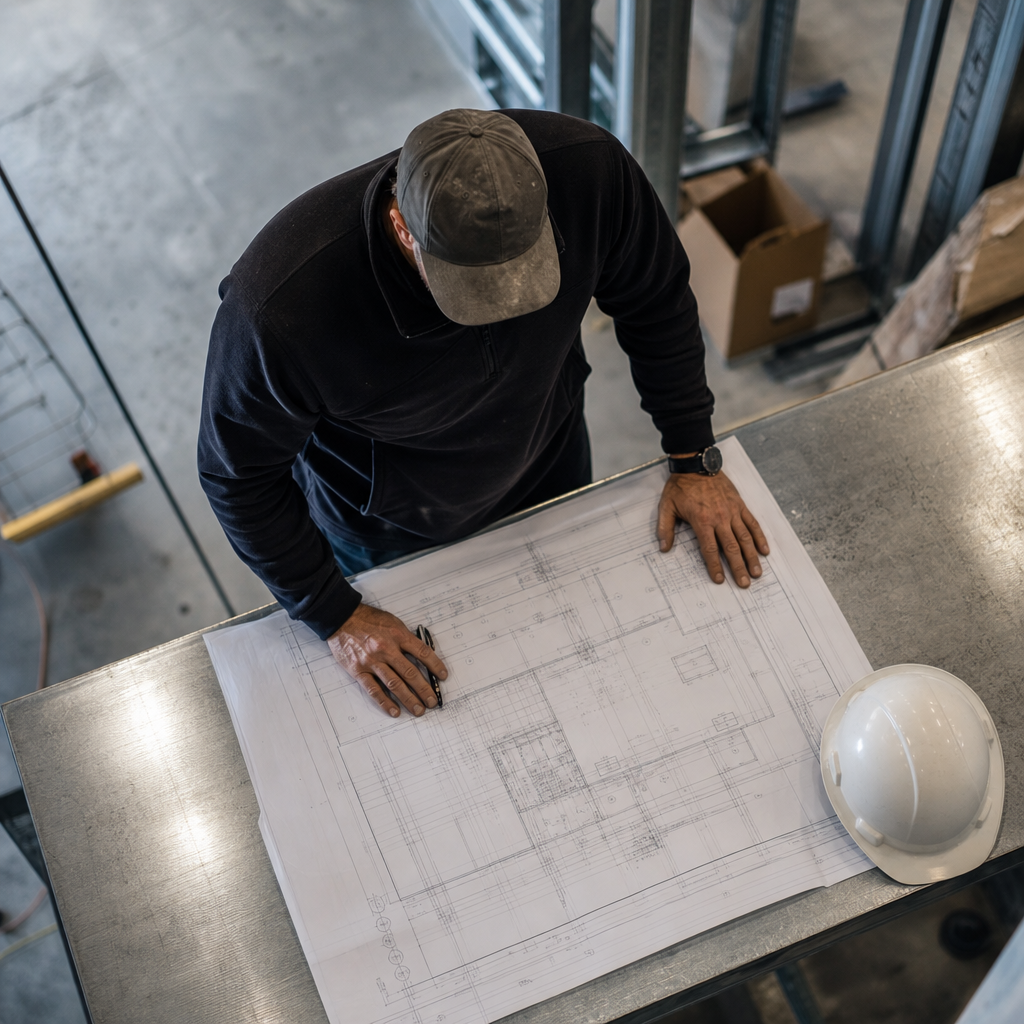
Budgeting for commercial spray foam insulation requires accounting for applicable building codes, occupancy types, and project specifications. Depending on local building code requirements and wall or ceiling assemblies, exposed foam in certain occupied spaces may require an approved thermal barrier or protective coating.
Thermal and Ignition Barrier Requirements
Depending on local building regulations and the specific assembly design, spray polyurethane foam may need to be separated from interior occupied spaces by an approved thermal barrier, such as half-inch gypsum board, or an approved protective covering or coating where specified by code or project plans.
Coating and Finish Considerations
When specialty fire-protective or intumescent coatings are required by project specifications or local building officials, they represent an additional line item in the installation budget. Always verify whether protective coatings or sheetrock coverings are required for your specific building use and ensure these details are clarified in your contractor quotes.
HVAC Sizing and Energy Case Studies
Need commercial spray foam insulation cost?
We’re available now — call for a fast, free estimate.
Looking only at upfront installation cost gives an incomplete picture of total expenditure. Improved thermal insulation and air sealing can impact mechanical equipment requirements and operational costs in commercial spaces.
Mechanical Equipment Sizing Considerations
Air leakage through traditional insulation assemblies can increase thermal loads on HVAC systems. Spray foam provides continuous insulation that seals air pathways. In specific engineering case studies and modeled retrofits, tighter building envelopes have allowed designers to downsize HVAC cooling capacity, potentially reducing upfront mechanical equipment expenditures.
Energy Savings and Case-Study Outcomes
Project data and case studies from Super Green Insulation Austin indicate that air sealing combined with increased thermal resistance can noticeably reduce heating and cooling energy use compared to uninsulated or minimally insulated metal structures. While actual return on investment and payback periods depend heavily on utility rates, building schedule, and climate, improved thermal envelopes consistently reduce ongoing conditioning demands.
Choosing a Commercial Insulation Contractor in Austin
Commercial spray foam application requires specialized proportioner rigs, exact temperature and pressure controls, and trained technicians. Selecting an experienced contractor ensures proper application ratios, substrate adhesion, and code compliance.
Verifying Credentials and Scope Details
Before signing a commercial insulation contract, confirm the following items with each bidder:
- Insurance and Bonding: Confirm commercial general liability coverage, commercial auto policies, and workers’ compensation.
- Detailed Specifications: The bid should state the exact foam type, density (open-cell vs. closed-cell), target thickness in inches, total square footage, and any specified protective coatings.
- Site Safety and Ventilation: Commercial rigs require safety plans, proper ventilation setups, and planned re-entry schedules for other construction trades.
Evaluating Commercial Estimates
Be cautious of estimates that come in substantially below standard commercial ranges. Unusually low bids may indicate skimping on specified thickness, omitting required coatings, or using improper application techniques. Spraying foam below specified thickness reduces R-value and can compromise air-barrier performance. Work with established contractors like Super Green Insulation Austin who provide clear scopes, verified depth checks, and proven commercial experience.
Frequently Asked Questions About Commercial Spray Foam Insulation Costs
How much does commercial spray foam insulation cost per square foot?
Commercial spray foam generally ranges from $0.50 to $3.00 per square foot installed. Specific commercial applications, such as warehouses, cold storage, and commercial roofing, typically run between $0.75 and $2.25 per square foot. Pricing varies depending on foam type, thickness, and total project size, with volume discounts often available for projects exceeding 10,000 square feet.
What factors impact the cost of commercial spray foam insulation?
Key cost factors include total square footage, applied foam thickness, substrate preparation, building height and lift access, foam density, and whether additional protective or fire-retardant coatings are required by project specifications.
What is the difference in cost between open-cell and closed-cell spray foam for commercial properties?
Open-cell foam is generally less expensive per square foot installed than closed-cell foam. However, closed-cell provides higher R-value per inch (R-6.5 to R-7.0 vs. R-3.7), acts as a vapor retarder at 1.5 inches, and adds structural rigidity, making it common for metal buildings and roofing applications.
How much does commercial spray foam roofing cost?
Commercial spray polyurethane foam (SPF) roofing systems generally range from $4.00 to $6.00 per square foot at 1.5 inches with a 10-year warranty topcoat, $5.00 to $7.00 at 2 inches, $6.50 to $9.00 at 3 inches, and $8.00 to $11.00 at 4 inches.
What are the potential energy and equipment savings of commercial spray foam?
Case studies show that the effective air sealing and thermal resistance of spray foam can reduce mechanical cooling loads and cut commercial heating and cooling expenses compared to poorly insulated assemblies. In some project designs, this allows for smaller HVAC equipment and lower ongoing utility bills.
How does spray foam compare in cost to traditional commercial insulation?
Spray foam generally requires a higher initial investment than basic fiberglass or cellulose batts. However, spray foam provides combined air sealing and thermal insulation in a single application, helping reduce air infiltration and improving climate control in hot and humid regions.
Need commercial spray foam insulation cost?
We’re available now — call for a fast, free estimate.
Sources
- Spray Foam Guidec – Energy.gov – www1.eere.energy.gov
- Spray Foam Market Size & Share, Forecasts Report 2026-2035 – gminsights.com (2035)
Related reading: Crawl Space Moisture Barrier Cost: Cut Surprises Before You Sign
Related reading: Crawl Space Encapsulation Price – Get a Clear Quote, Not a Guessing Game
Related reading: How to Price Insulation Installation Without Surprises
Frequently Asked Questions
How do corrugated metal decks and high ceilings affect the final commercial spray foam estimate?
Corrugated siding and fluted roof decks add 15% to 25% more sprayable surface area than flat floor plans, while high clear heights introduce specialized lift equipment costs. Super Green Insulation Austin performs detailed on-site 3D measurements to accurately calculate these structural variations, ensuring your commercial spray foam insulation cost remains transparent without mid-project change orders.
Do commercial building codes in Central Texas require extra fire-protective coatings over spray foam?
Yes, local commercial building codes frequently mandate an approved thermal barrier, such as half-inch gypsum board or an intumescent fire-retardant coating, when foam is left exposed in occupied spaces. Super Green Insulation Austin explicitly itemizes these required ignition barriers and coatings in your initial proposal so your facility passes inspection smoothly.
Can commercial spray foam installation help downsize HVAC equipment during new construction?
Yes, because spray foam simultaneously provides high thermal resistance and an airtight envelope, mechanical engineers can often specify smaller HVAC cooling tonnage for the facility. Super Green Insulation Austin provides expert R-value engineering data to help facility owners capture these upfront mechanical equipment savings alongside long-term utility reductions.
About the author
 |
Marcus Donovan Marcus Donovan is a certified energy auditor and home performance specialist with over 12 years of experience in the Austin construction industry. He holds a Bachelor of Science in Construction Management from Texas State University and focuses on residential and commercial energy efficiency. His practical knowledge covers everything from attic insulation retrofits to complex moisture control systems. |