
CertainTeed Insulation in Southwest Austin, TX | Super Green Insulation Austin
If your Southwest Austin home is running your AC harder every summer and you still can’t get the upstairs to cool down, degraded or improperly installed insulation is almost always part of the story. At Super Green Insulation Austin, we’ve been installing and servicing CertainTeed insulation products across Southwest Austin for over 16 years — and we know exactly how this area’s homes behave. Call us today at (866) 434-2901 to schedule your assessment.

Why Southwest Austin Residents Choose Us for CertainTeed Service
Tom Hopkins has led our crew since day one, and that consistency shows in our results: 784 verified reviews averaging 4.9 out of 5 stars, the majority of them from homeowners right here in Southwest Austin. We’re not a manufacturer rep or a franchise — Super Green Insulation Austin is an independent CertainTeed service provider, which means we give you straight talk about what your home actually needs rather than what sells a package.
Our technicians are trained specifically on CertainTeed product lines and installation standards. We keep commonly used CertainTeed materials stocked and ready, which cuts lead times considerably for customers in ZIP codes 78735, 78749, and 78733. When a project comes up in Circle C Ranch or Barton Creek, we’re not waiting on a supply truck from another region.
The Southwest Austin Thermal Problem Nobody Warns You About
Southwest Austin isn’t flat-terrain Austin. The neighborhoods along Barton Creek and up into Westlake Hills sit on the Balcones Escarpment — homes here were cut into steep limestone hillsides during the custom-build boom of the 1980s through early 2000s, and they came with architectural choices that standard insulation approaches simply don’t accommodate. Vaulted great rooms, floor-to-ceiling glazing pointed at canyon views, irregular multi-level rooflines: these features create thermal bridging problems and attic geometries that defeat a basic blown-in job.
On a peak July afternoon, attic cavities in this part of Southwest Austin routinely hit 140–150°F. The limestone substrate underneath retains that heat well into the night, which shortens the natural cooling window your home would otherwise get. Add in the fact that many of these hillside homes have a lower garage or utility level that opens directly to the outside on the downhill face — an uninsulated ceiling that dumps radiant heat straight into the living space above — and you have one of the most undertreated thermal vulnerabilities in the entire area. That lower-level ceiling is often the single highest-value spray foam target on the whole property, and most inspectors walk right past it.
February 2021 reinforced all of this. Winter Storm Uri hit Westlake Hills and Barton Creek hard, freezing pipes in high-end custom homes that simply didn’t have adequate wall or attic insulation for that kind of sustained cold. Since then, we’ve seen sustained demand from Southwest Austin homeowners who want their thermal envelope done right — not just well enough for a normal Texas winter, but genuinely resilient.
Common CertainTeed Insulation Problems We Solve in Southwest Austin
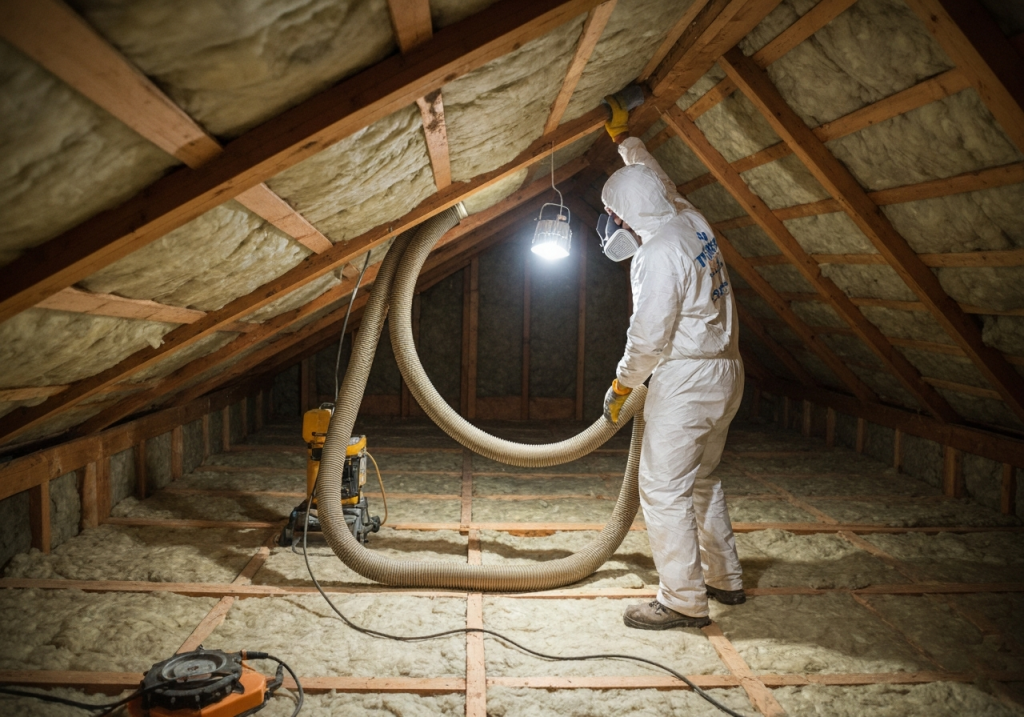
- Compressed, aging blown fiberglass in Circle C Ranch attics. The mid-1990s production homes throughout Circle C Ranch (78749) were built with builder-grade blown fiberglass that’s now 25 to 30 years old, settled into a fraction of its original depth, and performing well below the R-38+ standard current code requires. CertainTeed’s blown fiber products restore proper R-value coverage, and we pair the install with air sealing to address the gaps that opened up as the original material compressed over the decades.
- Thermal bridging in vaulted ceiling assemblies. Custom homes near Bee Caves Road and throughout the Barton Creek corridor frequently have cathedral ceilings where insulation was installed with insufficient depth or missing vapor retarder coverage. CertainTeed’s faced batt systems, properly sized for the rafter cavity, address the bridging that keeps those rooms warm even when the AC is maxed out.
- Radiant heat load from complex, multi-pitch rooflines. Homes with irregular rooflines along South Mopac Expressway corridors have attic sections that were either left uninsulated during original construction or received piecemeal coverage over the years. We assess the full geometry and install CertainTeed’s radiant barrier and blown-in systems to address every section consistently, not just the easy-access areas.
- Uninsulated downhill-facing lower levels. As we described above, the partially conditioned lower garage and utility spaces on hillside homes in Westlake Hills and Barton Creek are routinely skipped. Spray foam applied to those ceilings stops the heat transfer path cold — homeowners typically notice the difference in the room directly above within the first full summer.
CertainTeed Models & Products We Service in Southwest Austin
We work with the full residential CertainTeed insulation line, including CertainTeed InsulSafe SP blown-in fiberglass, CertainTeed CertaSpray open- and closed-cell spray foam, CertainTeed Membrain smart vapor retarder, and CertainTeed ProRox mineral wool batt products. For Southwest Austin’s high-radiant-load attics, we also install CertainTeed’s ThermaFiber and radiant barrier-compatible assemblies. Commonly needed materials for this market are kept in local stock, so we’re not adding weeks to your project timeline.
Service Areas Near Southwest Austin
Our Southwest Austin work extends naturally into the surrounding areas we serve every week. We regularly complete CertainTeed insulation projects in South Austin, Downtown and Central Austin, Northwest Austin, and North Central Austin. If you’re on the edge of Southwest Austin near Bee Caves Road or closer to the Oak Hill area, we cover you — call (866) 434-2901 to confirm coverage for your address.
Serving Southwest Austin, TX — Our Local Coverage Area
We’re based in the Southwest Austin area and know this community well. Use the map below to see our service coverage — if you’re nearby, we can almost certainly help.
Book Your CertainTeed Service in Southwest Austin Today
Don’t let another Austin summer push your cooling bills higher than they need to be. Tom Hopkins and the Super Green Insulation Austin team are ready to assess your home, recommend the right CertainTeed solution for your specific Southwest Austin property, and get the work scheduled fast. Same-day consultations are available for many Southwest Austin addresses. Call us now at (866) 434-2901 — let’s get your home where it should be.
Written by the team at Super Green Insulation Austin, serving Southwest Austin since 2008.