
Quick Summary
High indoor humidity often plagues Austin homes when humid outdoor air constantly infiltrates living spaces through unsealed attics and crawl spaces, overwhelming standard HVAC systems. Super Green Insulation Austin permanently addresses lowering indoor humidity at the building envelope source through comprehensive air sealing, high-performance insulation, and ground vapor barriers rather than temporary cooling fixes. Homeowners will understand how structural air leaks drive moisture issues and can contact the team today to schedule an on-site moisture evaluation or request a free estimate.
Lowering Indoor Humidity: Fast Fixes for Austin Homes
Managing indoor moisture in Central Texas is a constant battle against outdoor air. In humid climates, air leaks and moisture sources can make humidity harder to control. The result is a house that feels clammy and heavy, even when your air conditioner runs from morning until night.[1]
Turning the thermostat down to forced low temperatures might cool the air, but it runs up your electric bill without solving the root problem. High humidity can result from air leaks, ventilation issues, HVAC performance, and indoor moisture sources. Stopping moisture intrusion requires closing air leaks in your ceiling and attic, protecting crawl spaces, and ensuring your insulation works alongside proper ventilation, as noted by Super Green Insulation Austin.[4]
How to Lower Indoor Humidity: Quick Summary and Next Steps
EPA guidance recommends 30% to 50% RH, and staying below 60% helps avoid excess moisture problems. You achieve this by managing everyday moisture sources, running exhaust fans, using dehumidifiers where appropriate, and sealing gaps in your home’s thermal boundary. In humid climates, air leaks and moisture sources can make humidity harder to control if humid outdoor air constantly leaks through ceiling penetrations, unsealed top plates, and duct cutouts.[5]
Lower humidity can help reduce mold-related moisture problems and dust mites throughout the house.
Key Takeaways for Austin Homeowners
- Target 30% to 50% Relative Humidity: EPA guidance recommends 30% to 50% RH, and staying below 60% helps avoid excess moisture problems while reducing dust mites.
- Seal Attic Air Bypasses: Cooling units struggle when outdoor moisture constantly enters through recessed lights, attic access hatches, and wall top plates.
- Fix the Building Envelope First: Address the structural gaps where humid air enters before investing in oversized cooling equipment or extra standalone appliances.
What Is the Ideal Indoor Humidity Level for a Central Texas Home?
EPA guidance recommends 30% to 50% RH, and staying below 60% helps avoid excess moisture problems. Lower humidity can help reduce mold-related moisture problems and dust mites.[3]
In Austin, keeping indoor moisture in this range requires deliberate planning. While winter cold fronts can briefly dry out indoor air, our long cooling season continuously pushes outdoor moisture against every seam in your house.
Health and Structural Risks of Relative Humidity Over 60%
When moisture stays above 60% for extended periods, excess moisture problems can develop. Lower humidity can help reduce mold-related moisture problems and dust mites. That same moisture can migrate into wall cavities, where it softens drywall and causes hardwood floors to cup or buckle over time.
Common Warning Signs of Excessive Moisture Indoors
- A persistent musty smell in closets, hallways, or near baseboards
- A cold, clammy feeling on your skin while the AC is running
- Condensation gathering on interior window panes or exposed cold water lines
- Peeling paint, bubbling drywall tape, or swollen door frames
If you notice these signs despite running your AC, hidden air leaks in your attic or crawl space are likely pulling outside moisture directly into your living areas.
Why Is Your House Humid Even with the Air Conditioner Running?
Need lowering indoor humidity?
We’re available now — call for a fast, free estimate.
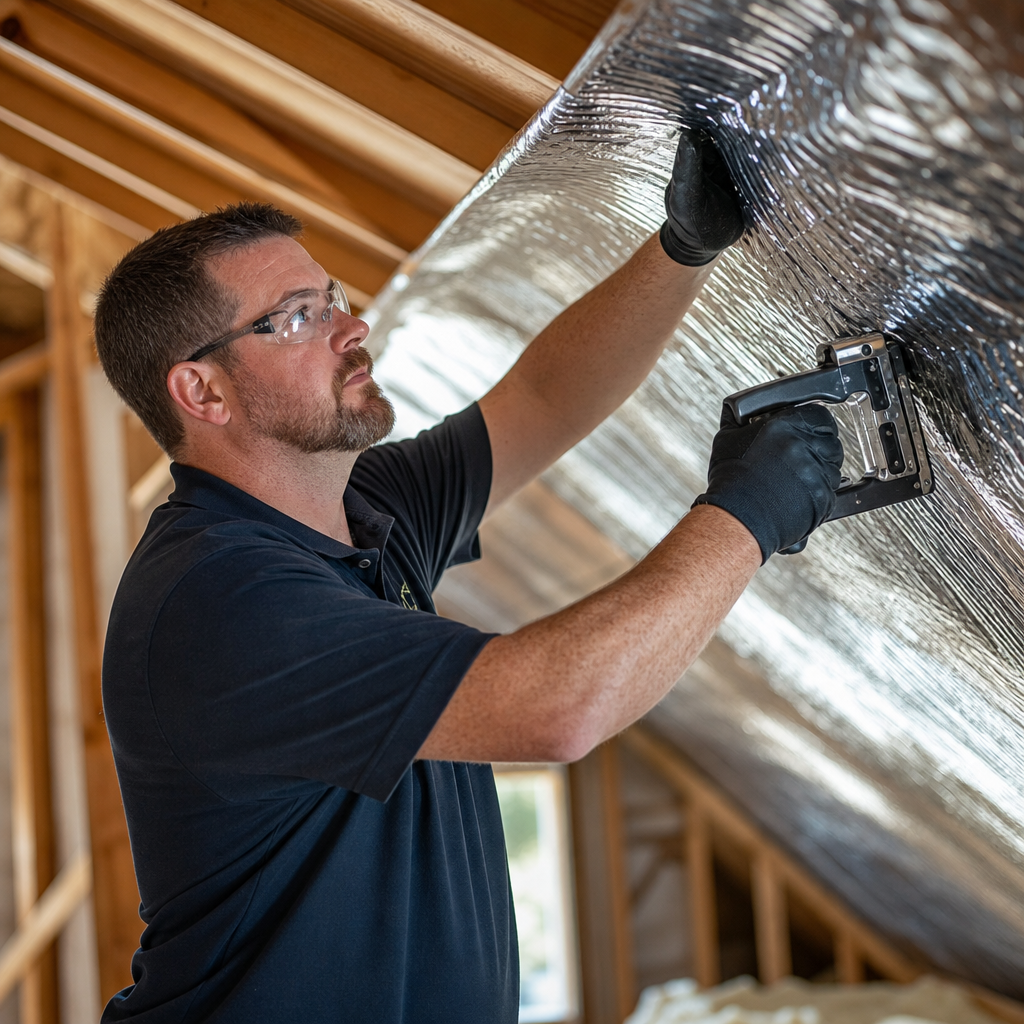
An air conditioner cools by extracting both heat and moisture from the air. However, humidity can persist when HVAC is short-cycling, undersized, poorly maintained, or when moisture infiltration continues.
The Attic Envelope Pressure Problem Explained
In humid climates, air leaks and moisture sources can make humidity harder to control. During hot summer afternoons, unconditioned attic temperatures can top 130 degrees. This superheated air rises and exits through ridge and soffit vents, creating a natural chimney effect known as the stack effect.
As hot air escapes the top of the roof, it creates negative air pressure in the living spaces below. This negative pressure pulls hot, moisture-laden attic air straight down through ceiling can lights, electrical boxes, and wall cavities. At the same time, the extreme attic heat warms the upper side of your drywall ceiling, creating condensation spots where that heat meets cooled indoor air.[2]
HVAC Short-Cycling vs. Air Infiltration
Humidity can persist when HVAC is short-cycling, undersized, poorly maintained, or when moisture infiltration continues. An oversized system cools the house too fast and shuts off before its evaporator coil has time to pull moisture out of the air. To solve the problem, you must seal air leaks at the building boundary so a properly maintained and sized HVAC system can run full, balanced cooling cycles that effectively wring water from the air.
Comparing Methods for Lowering Indoor Humidity in Texas Homes
Balancing indoor moisture involves combining mechanical equipment with structural improvements. Controlling the building boundary stops moisture at the source, making mechanical systems far more efficient.
Temporary Fixes vs. Permanent Building Envelope Solutions
Portable dehumidifiers can help dry out a single damp room, but they dump heat back into your living space and do nothing to stop the flow of humid air from an unsealed attic. Whole-house dehumidifiers manage moisture loads across ductwork, but they consume additional power if your building envelope remains drafty. Sealing attic air leaks and upgrading thermal barriers permanently lowers the amount of water vapor entering your home.
| Feature | Portable Dehumidifier | Whole-House Dehumidifier | Air Sealing & Insulation |
|---|---|---|---|
| Best Application | Single-room moisture issues | Centralized moisture removal across ductwork | Stopping outdoor moisture at the building boundary |
| Moisture Control Method | Extracts water vapor locally | Removes moisture across supply ducts | Blocks humid outdoor air from leaking inside |
| Long-Term Impact | Treats symptoms in small zones | Mechanically balances indoor humidity | Permanently reduces the home’s latent cooling load |
The Role of Spray Foam and Vapor Barriers in Moisture Control
According to Super Green Insulation Austin, spray foam insulation and ground vapor barriers target the physical paths moisture takes into a home. When properly installed, spray foam can help air seal and reduce infiltration along the roof deck or exterior walls, helping prevent condensation along duct runs. In homes with pier-and-beam foundations, heavy-duty ground vapor barriers stop damp soil moisture from rising through subflooring into your living spaces.
Factors That Influence Moisture Mitigation and Insulation Projects
Targeting ceiling penetrations and structural leaks provides a permanent foundation for stable indoor humidity throughout Central Texas.
Key Factors That Shape Project Scope
Every home requires an approach based on its layout and age:
- Attic Size and Roof Pitch: Usable square footage, roof height, and framing accessibility determine the time and materials needed.
- Existing Insulation Removal: Clearing out old, dusty, or rodent-damaged insulation is necessary before technicians can cleanly seal ceiling top plates and electrical penetrations.
- Air Sealing Extent: Sealing plumbing chases, wire runs, flues, and recessed light housings prevents attic air from entering conditioned rooms.
- Material Selection: Choosing between blown-in cellulose, blown-in fiberglass, closed-cell spray foam, or crawl space vapor barriers based on the property’s design.
Choosing the Right Insulation Contractor
Fixing humidity requires a contractor who understands building science, airflow dynamics, and local climate pressures, standard practices followed by professionals like Super Green Insulation Austin. Look for a team that offers clear, upfront pricing, provides transparent diagnostics, and carries full licensing and insurance. A properly sealed attic stabilizes indoor temperatures during winter cold snaps and eliminates summer moisture buildup.
Frequently Asked Questions About Lowering Indoor Humidity
Can spray foam insulation prevent humidity and moisture problems?
When properly installed, spray foam can help air seal and reduce infiltration along the roof deck or exterior walls, helping reduce the amount of humid outdoor air that penetrates the living envelope.
Does proper attic insulation help lower summer electric bills in Austin?
Yes. By preventing attic heat transfer and stopping hot air leaks, proper insulation reduces the workload on your air conditioner. This allows the system to maintain set temperatures without running non-stop, lowering your monthly utility costs.
How does air sealing work alongside dehumidifiers and air conditioning?
Air sealing closes the gaps around lights, pipes, and wall framing that draw in outdoor air. This drastically reduces the volume of moisture entering your home, allowing your air conditioner and dehumidifiers to keep relative humidity within recommended ranges with less run time.
Need lowering indoor humidity?
We’re available now — call for a fast, free estimate.
Sources
- Moisture Control – epa.gov (2013)
- Indoor Humidity Levels and Associations with Reported … – stacks.cdc.gov (2022)
- Reducing relative humidity is a practical way to control dust … – pubmed.ncbi.nlm.nih.gov (2001)
- INDOOR HUMIDITY LEVELS AND ASSOCIATIONS WITH … – pmc.ncbi.nlm.nih.gov
- Improving Comfort in Hot-Humid Climates with a Whole- … – energy.gov
Related reading: Lowering Humidity – Call Now-10% Off – Same-Day Service – Free Estimate
Related reading: Home Humidity Levels in Winter | Call Now-10% Off | Same-Day Service | Free Estimate
Related reading: Home Humidity in Winter – 10% Off & Free Estimate – Same-Day Service
Frequently Asked Questions
How does crawl space encapsulation help with lowering indoor humidity in Austin homes?
In pier-and-beam homes, ground moisture evaporates directly from the soil and migrates upward through subflooring into living areas. Super Green Insulation Austin installs heavy-duty ground vapor barriers to block this rising moisture before it enters the living space and overloads your cooling system.
What happens during an on-site attic and crawl space moisture evaluation?
A technician inspects thermal boundaries, attic bypasses, and foundation spaces to detect where outdoor air and water vapor enter the structure. Super Green Insulation Austin uses these diagnostics to create a targeted plan combining air sealing, vapor barriers, and insulation to permanently lower humidity.
Will air sealing my attic create indoor air quality issues by making the house too airtight?
Targeted air sealing eliminates uncontrolled, humid drafts through ceiling bypasses rather than stopping healthy airflow. Super Green Insulation Austin ensures thermal boundaries work in harmony with proper home ventilation, keeping fresh air circulating while maintaining relative humidity between 30% and 50%.
About the author
 |
Marcus Donovan Marcus Donovan is a certified energy auditor and home performance specialist with over 12 years of experience in the Austin construction industry. He holds a Bachelor of Science in Construction Management from Texas State University and focuses on residential and commercial energy efficiency. His practical knowledge covers everything from attic insulation retrofits to complex moisture control systems. |